The initial industrial field trials validating this new geochemical prospecting method were succesfully conducred in 1991.
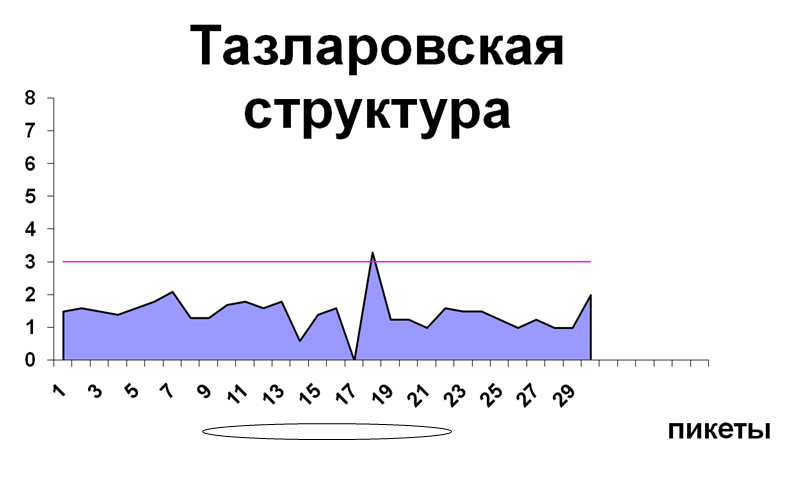
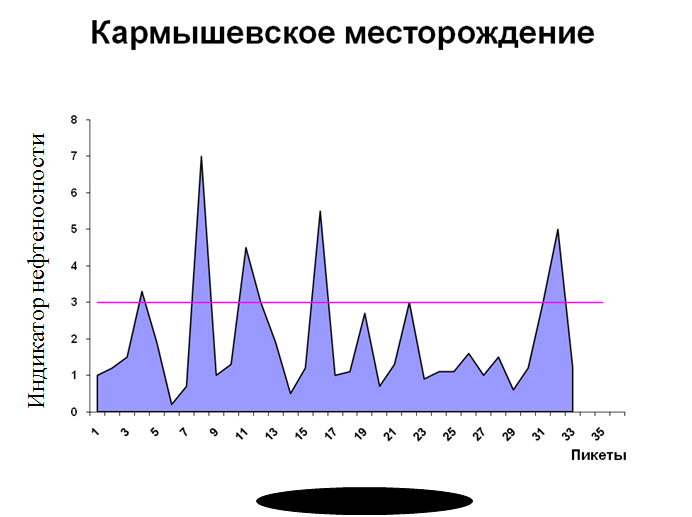
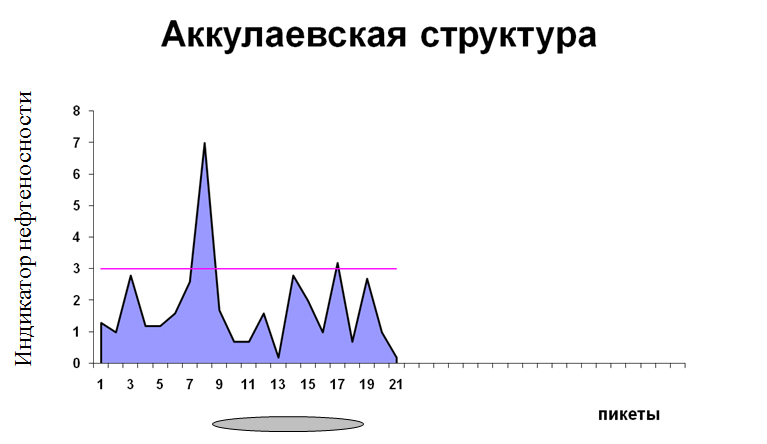
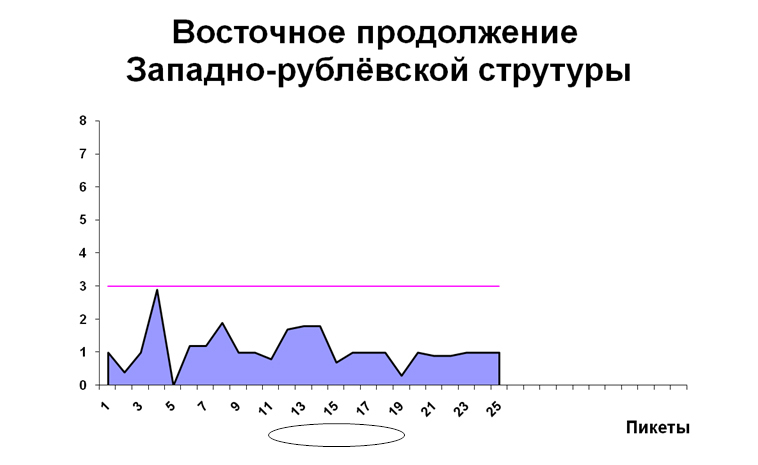
Figures 1, 2, 3 and 4 illustrate a case study of the technology applied to evaluate the hydrocarbon potential of seismic prospects within the platform zone of the Volga-Ural basin (Bashkortostan).
Survey Parameters:
— Sampling Depth: 0.5 meters (subsurface soil layer)
— Sampling Interval: 50-meter station spacing along the profile
— Y-axis: Composite Oil-Bearing Indicator (OBI)
— X-axis: Soil sampling stations along the profile crossing the seismic structures.
Soil sampling was carried out along profiles intersecting reference seismic targets with distinct well-proven drilling outcomes:
1. Hydrocarbon Reservoir Absent (Barren/Dry Structures):
— Fig.1 — Eastern extension of the West-Rublevskaya structure.
— Fig. 2 — Tazlarovskaya structure.
2. Proven Productive Reservoir:
— Fig. 3 — Karmyshevskoye oil field.
3. Blind Target Exploration (Pre-Drilling Prediction):
— Fig. 4 — Akkulayevskaya seismic prospect.
Рт
Fig. 1 Dry structure
Fig. 2. Dry structure
Fig. 3. Confirmed oil-bearing structure
Fig. 4. Confirmed by drilling
Data Interpretation &Exploration Outcomes
The field data clearly demonstrate the high contrast and reliability of the technology:
— Barren Prospects (Fig.1, 2): Above structures that lack hydrocarbon charge, the Oil-Bearing Indicator consistently remains within the baseline natural background range.
— Proven Oil Field (Fig. 3): Above the crest and flanks of the productive structure, a powerful geochemical anomaly is detected, with indicator values exceeding the background baseline more than twofold.
— Exploration Target (Fig. 4): Above the unproven Akkulayevskaya seismic prospect, an abnormally high indicator response was detected on one of the structure’s flanks, suggesting a high-probability hydrocarbon charge.
— Drilling Verification: Subsequent exploratory drilling fully confirmed the geochemical prediction — a commercial oil discovery was successfully made within the mapped structure.
2016 Industrial Field Trials (Bashneft Oil Company Case Study).
In 2016, a
comprehensive commercial field trial program was executed on the license blocks
of PJSC «Bashneft» (Bakaly district, Republic of Bashkortostan) to
evaluate the predictive power of the technology.
The project
was conducted as a strict Blind Test mapping program. The survey
matrix included:
·
1 Reference
Barren Prospect (Block No. 6) — for regional
background calibration.
·
3 Unproven
Seismic Prospects (Blocks No.
1, No. 3, and No. 5) — with unknown hydrocarbon potential.
Field Logistics & Parameters:
·
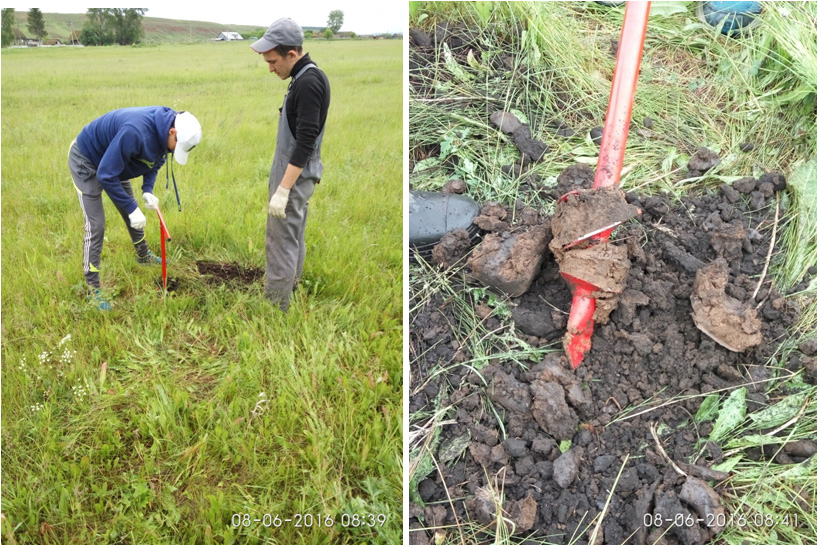
Sampling
Method: Manual/portable auger
sampling from the subsurface layer at a depth of 1 meter.
·
Station
Spacing: 100-meter interval
between sampling points along the profile.
·
Profile
Extension: To capture accurate
background baselines, profiles extended 500 meters beyond the mapped seismic
boundaries on both entry and exit sides.
·
Packaging: Collected soil (~100g) was stored in standard heavy-duty paper bags. No
special preservation, airtight containers, or temperature-controlled
transportation were required.
·
Data
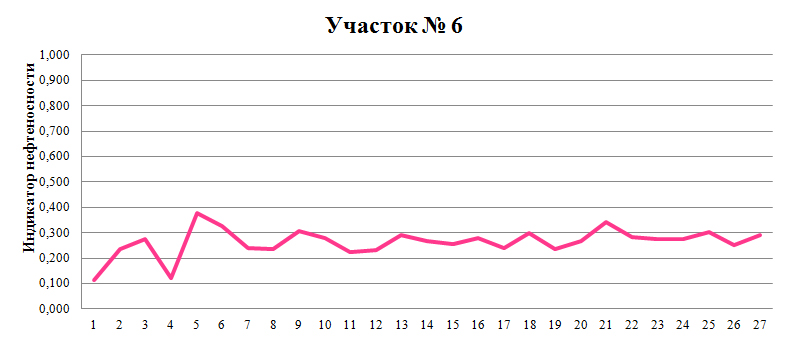
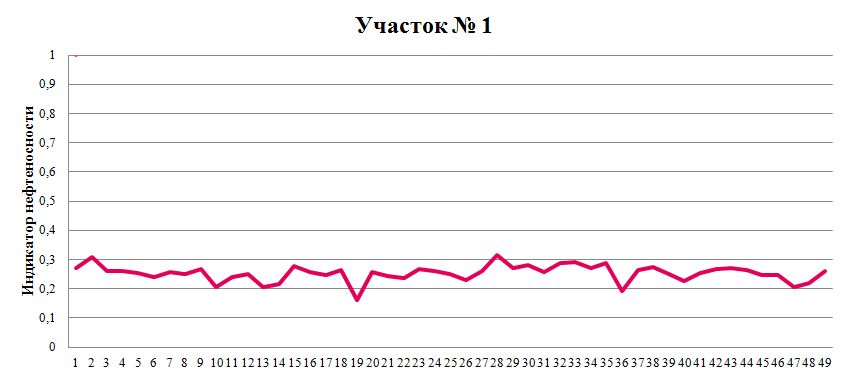
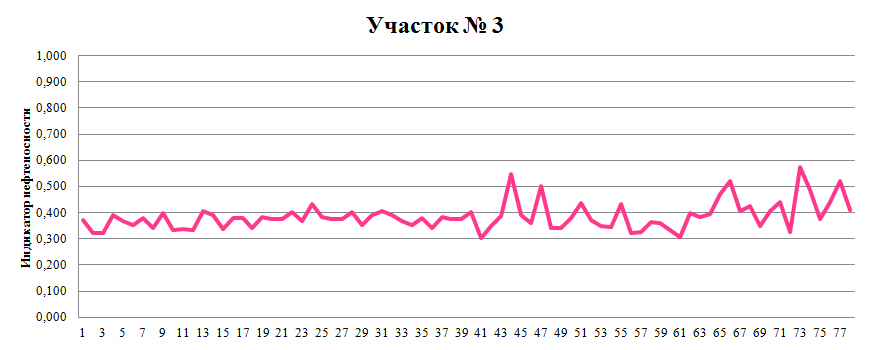
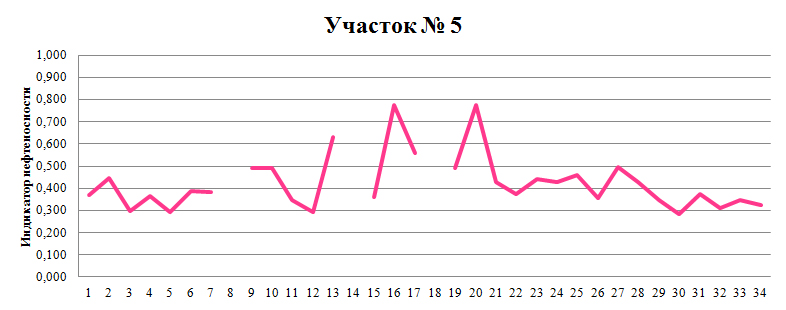
Visualization: Y-axis: Composite Oil-Bearing
Indicator (OBI). X-axis: Soil sampling stations across the prospect.
Exploration Outcomes & Data Analysis
Block No. 6 (Reference Barren Target)
— Data Response: The Oil-Bearing Indicator remained low and flat across the entire profile, never exceeding the baseline value of 0,4 units.
— Pre-Drilling Prediction: Barren/Dry structure.
Block No. 1 (Unproven Prospect)
— Prospect Size: 5,5 x 2,3 km.
— Data response: The indicator values mirrored the background baseline, staying below 0,4 unites.
— Pre-Drilling Prediction: Barren/Dry structure.
Block No. 3 (Unproven prospect)
— Prospect Size: 8 x 3 km.
— Data Response: Stations 1 to 42 showed standard background levels. Stations 43 to 77 revealed a prominent anomaly, with indication values shifting 50% or more above the baseline.
— Pre-Drilling Prediction: Partially Productive (hydrocarbon accumulation is constrained to the second half of the seismic structure).
Block No. 5 (Unproven Prospect)
— Prospect Size: 2,5 x 1 km.
— Data Response: The central segment of the profile exhibited a sharp, high-contrast peak, with indicator values exceeding the background baseline by approximately 200% (twofold).
— Pre-Drilling Prediction: Highly Productive/Oil-bearing structure.
Following the analysis, an official pre-drilling hydrocarbon prediction report was submitted to the operator.
Drilling Verification & Official Endorsement
Drilling Outcomes: Subsequent exploratory drilling campaigns conducted by PJSC «Bashneft» fully confirmed our geochemical predictions with 100% accuracy across all surveyed blocks. The success of the project is formally documented in an official validation letter issued by the oil company’s management.